Wednesday, 16 October 2019

TRAVELOGUE

TRAVELOGUE


What Is a Travelogue?

If you think that “travelogue” only refers to something in a written form decorated with a few pictures, you would be wrong. Of course, a piece of writing is the first thing that we imagine when we hear this word. Still, a story about the journey can also be demonstrated as a motion picture, lecture, or talk accompanied by photos or a presentation. In our guide, we’ll talk about a travelogue with an essay-type structure. However, you are free to use certain tips for other forms of travelogues.


Example of Travelogue: Koktebel


Land Of The Blue Hills
Many beat-up travelers claim that the country of contrasts is India. It can be described as a rich land where poor people live. I did not have a chance to see this with my own eyes, but I was lucky to visit the place that greatly impressed me with its great diversities. Situated on the picturesque shore of the Black Sea, Koktebel is one of the most popular resorts in Crimea, and I really understand why.
When I visited it for the first time, I was astonished by its calmness. Being in the city was like being in a deep dream. One morning, the beaches were empty except for some romantic couples sitting on the sand with coffee thermoses, waiting for the sunrise. The lighting produced by the sunrise can be quite magical. Sadly, however, this most impressive part of the day occurs before many people wake up. But, thank goodness, that day I was among those people who set their alarm clocks a bit early to enjoy the beauty of the moment. I wondered why this place was known as “the land of the blue hills”. It would be better to call it “the land of the best sunrises”.
Nevertheless, I understood in just a few minutes. I looked away from the sunrise on the horizon and saw the heavy clouds invading the top of the mountains, covering them scene gave the impression of visiting the land of the blue hills.
After enjoying such an amazing scene, I went to the hotel to take a rest. There are several choices in which to stay in Koktebel. Accommodations can be either in a small hotel or in one of the hundreds of guesthouses run by local residents. It seems as though the whole population there turns into innkeepers in the summer. They gladly meet the tourists and do their best to satisfy all their needs. However, if you want to be closer to nature, you may stay in a tent camp. Staying in a tent is a great way to be in the fresh air. If you need camping assistance, many travelers are at your service to provide friendly and helpful advice. I thought that it would be great to stay in a camp next time.
When I decided to explore my recreation place, I took a walk in the direction of the bay. What I saw was a mixture of public and private beaches with a paved walkway all along the bay. This walkway was lined with small restaurants, cafes, kiosks, and small market areas selling all types of goods such as arts and crafts, dried fish, or slices of home-baked cake. I felt as if I was not in Ukraine, but abroad. The cuisine was predominantly Tatar, so I had a chance to enjoy these traditional dishes. Frankly speaking, I was surprised by the fact that I was in Ukraine, but there were only a few places where I could find Ukrainian food. Later the local people explained to me this phenomenon has a historical background.
Koktebel is known by making good wines and cognacs. So my advice to you, if you visit there one day, is to try the wine and take a bottle with you as a present for friends. A glass of red wine with a delightful supper in one of the small, quaint restaurants on the bay will make your evening unforgettable. To better experience this atmosphere, I went on an excursion at the wine and cognac factory. I saw the process of making such wonderful wines with my own eyes. The process is tough and requires much effort, but many years of constant practice shows the result.
In the evening, I decided to take a walk and relax. I was astonished by the fact that such a quiet place in the mornings came alive with many small music discos, drinks, food and entertainment in the evenings. The beachfront was alive; it was full of talented people presenting fire shows, singing and playing musical instruments. The atmosphere was amazing, and people were taking pictures of everything they saw, as all of us had a chance to watch a wonderful show.
Koktebel is now well-known for its jazz festival that usually takes place in the middle of September. Thankfully, I was lucky to experience this myself, as I came just in time. Ukraine hosts one of the largest music festivals in the world, with hundreds of music fans gathering there annually. As for me, I liked the festival for its unofficial and democratic spirit, induced by the place itself and the inspiring combination of jazz and the sea. The remarkable nature of the volcanic mountain range located near Koktebel, and the variety of wines and brandies grown in the vineyards nearby, completed the experience.
Related image

PERSONAL NARRATIVES

PERSONAL NARRATIVES

   <A personal narrative essay is about a personal experience, so it is usually written in the first person. To maximize its impact, the essay should:

  • Be written to have an emotional impact on the reader
  • Include a lot of references to sensory perceptions and emotions
  • Use vivid details and imagery
There are several types of personal essays in creative nonfiction. The most popular is the personal narrative essay or memoir essay. It focuses on a personal experience that is a turning point, a change in direction, an event that has significant meaning, and also shares a universal truth with readers

examples:
"It was the middle of springtime and across from my house where the incident took place. There was a lake there in which my brother and I loved to explore from time to time. The humidity and water drops where reminiscent of a fully functional sauna. The onslaught of heat and burning glow of the sun was relentless."
 Image result for personal narratives creative nonfiction

Monday, 14 October 2019

JOURNALISM / REPORTAGE

JOURNALISM / REPORTAGE

The term literary journalism is sometimes used interchangeably with CREATIVE NONFICTION more often, however, it is regarded as one type of creative nonfiction.
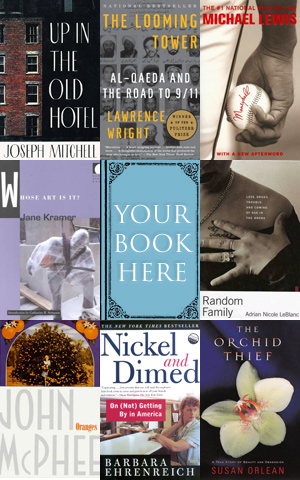
Highly regarded literary journalists in the U.S. today include JOHN MCPHEE, Jane Kramer, Mark Singer, and Richard Rhodes. Some notable literary journalists of the past century include Stephen Crane, Jack London, George Orwell, and Tom Wolfe.


     The genre of literary reportage is situated between journalism and literature. It has in common with journalism its relation to actuality. Reportage refers to cultural and social reality, past developments, and current affairs. ... As a result, it can hardly avoid providing stereotyped interpretations of reality.


  • Classic Examples of Literary Journalism

    • A Hanging by; George Orwell
    • The Sanfrancisco Earthquake by; Jack London
    • The Water Cress Girl by;Henry Mayhew

    • Reportage, for example, depicts a story or event in a report-like fashion. Unlike traditional styles of photography, reportage photographs are often less formal and portray their characters in a pose-free way that occurs naturally, not staged. However, in wedding reportage photography there is often direct intervention for images like group photos of the entire wedding party, and portraits of the bridge and groom.
      Photo reportage is quite common on stock photo agency websites, and mainly depict photos of reporters and photographers shooting at an event

Image result for JOURNALISM /REPORTAGE PICTURE

LITERARY

LITERARY

Literary terms refer to the technique, style, and formatting used by writers and speakers to masterfully emphasize, embellish, or strengthen their compositions. Literary terms can refer to playful techniques employed by comedians to make us laugh or witty tricks wordsmiths use to coin new words or phrases. They can also include the tools of persuasion that writers use to convince and drive audiences to action. With their carefully crafted speeches geared towards both logical and emotional thinking, they challenge our everyday modes of thinking.
Literary terms also include powerful figurative language that writers use to summon emotion ranging from guilt to anger to bliss, and to allow us to see the world in new and magical ways. Words can be arranged to give poems, songs, and prose alike, rhythm and musicality. They can animate a story with such wealth of detail, character development, and action that as readers, we are taken by a story, and feel as if the people on the page are real. Literary terms have a wide range of application, from the poet’s beauty, to the speaker’s persuasion, to the novelist’s story development.

EXAMPLES

Alliteration

Alliteration is a literary term that means two or more words in a row that all start with the same sounds. For example:
  • Three grey geese in a green field grazing, Grey were the geese and green was the grazing. - Three Grey Geese by Mother Goose
  • Many mumbling mice are making midnight music in the moonlight. - Dr. Seuss's ABC by Dr Seuss
  • What kind of bug is in the rosy red rectangle box? A bright blue big-mouth bug. - More Bugs in Boxes by David Carter
  • Two toucans tying ties, turtles tasting tea, and tigers trying trousers. - Faint Frogs Feeling Feverish and other terrifically tantalizing tongue twisters by Lilian Obligado
  • Runk lives in rain barrels and eats raindrops, rusty rainbows - Zoophabets by Robert Tallon

Hyperbole

Hyperbole is a literary term that refers to an exaggeration. Examples are:
  • Well now, one winter it was so cold that all the geese flew backward and all the fish moved south and even the snow turned blue. - Babe, the Blue Ox
  • It piled up to the ceiling.
It covered the floor.
It blocked the door.
It went down the hall.
It raised the roof - Sarah Cynthia Sylvia Stout Would Not Take The Garbage Out by Shel Silverstein
  • They have yarns
Of a skyscraper so tall they had to put hinges
On the two top stories so to let the moon go by - Yarns of the People by Carl Sandburg
  • There was an old woman tossed up in a blanket,
Seventeen times as high as the moon; - The Old Woman Tossed Up in a Blanket by Walter Crane
  • There was a Young Lady whose nose,
Was so long that it reached to her toes;
So she hired an Old Lady,
Whose conduct was steady,
To carry that wonderful nose. - Book of Nonsense Limerick 41 by Edward Lear

Metaphor

Metaphor is a literary term for comparing two things directly. Examples are:
  • The rain came down in long knitting needles. - National Velvet by Enid Bagnold
  • Above the hills, along the blue,
Round the bright air with footing true,
To please the child, to paint the rose,
The gardener of the World, he goes. - Summer Sun by Robert Louis Stevenson
  • I am the creamy white frost in vanilla ice cream
and the milky smooth brown in a chocolate bar
I am the midnight blue in a licorice stick
and the golden brown in sugar - Shades of Black: A Celebration of Our Children by Sandra L. Pinkney and Myles C. Pinkney,
  • Eagle gliding in the sky,
circling, circling way up high-
wind is whistling through your wings.
You're a graceful kite with no string. - Creatures from Earth, Sea, and Sky: Poems by Georgia Heard and Jennifer Owings Dewey
  • Let the rain kiss you
Let the rain beat upon your head with silver liquid drops
Let the rain sing you a lullaby
The rain makes still pools on the sidewalk
The rain makes running pools in the gutter
The rain plays a little sleep song on our roof at night
And I love the rain. - April Rain Song by Langston Hughes

Onomatopoeia

Onomatopoeia is a literary term used when a word imitates the sound it is describing. Examples are:
  • Pitter, patter. Pit. Pit. Patter. Splitter, splatter, down comes the rain - Chicky Chicky Chook Chook by Cathy MacLennan
  • Our washing machine went wishity whirr
Whisity whisity whisity whirr - Our Washing Machine by Patricia Hubbell
  • Bow-wow, says the dog,
Mew, mew says the cat,
Grunt, grunt, goes the hog,
And squeak goes the rat. - Animals by Mother Goose
  • When Pop drops pop-bottles
Pop-bottles plop!
Pop-bottle-tops topple!
Pop mops slop! - Song of the Pop-Bottlers by Morris Bishop
  • Susie's galoshes
Make splishes and sploshes
And slooshes and sloshes
As Susie steps slowly along in the slush. - Galoshes by Rhonda Bacmeister

Personification

Personification is a literary term for giving human attributes to objects or animals. Examples are:
  • Hey diddle, Diddle,
The cat and the fiddle,
The cow jumped over the moon;
The little dog laughed
To see such sport,
And the dish ran away with the spoon. - Mother Goose
  • There's a cat named Joe and you wouldn't want to know
But he thinks he'd like to be a Hippopotamus...
Oh, it wouldn't be so bad if he was certified as mad
But he's not... he holds a normal conversation - A Cat Named Jo by Leighton B Watts
  • My food loves to prance, to jump, to dance;
I wait for the time, I wait for the chance! - My Dinner Loves Dancing by L. John Riley Jr.
  • In the book The House Takes a Vacation by Jacqueline Davies: When the family goes on vacation, the house decides to go on vacation, too.
  • In Charlotte's Web by E.B. White: The pig and the spider converse throughout the book.
If you are looking for ways to translate this information into the classroom, check out this Literary Terms lesson plan. YourDictionary also has a Literary Terms Worksheet as well as terms which would be particularly important for the seventh grade and the high school student.

FORMS AND TYPES OF CREATIVE NON FICTION

AUTOBIOGRAPHY/ BIOGRAPHY

Definition of Biography
A biography also referred as ‘bio’ is a detailed account of a person’s life written or produced by another person. It gives an elaborate information regarding the birthplace, educational background, work, relationships and demise of the person concerned. It presents the subject’s intimate details about life, focusing on the highs and lows and analysing their whole personality.
A biography is usually in the written form but can also be made in other forms of a music composition or literature to film interpretation.
It is the recreation of the life of an individual composed of words by another person. The author collects every single detail about the subject and presents those facts in the biography, which are relevant and interesting, to engross the readers in the story.

Definition of Autobiography

An autobiography is the life sketch of a person written by that person himself or herself. The word auto means ‘self.’ Therefore, autobiography contains all the elements of a biography but composed or narrated by the author himself. He/She may write on their own or may hire ghostwriters to write for them.

An autobiography presents the narrator’s character sketch, the place where he is born and brought up, his education, work, life experiences, challenges, and achievements. This may include events and stories of his childhood, teenage, and adulthood.
BASIS FOR COMPARISONBIOGRAPHYAUTOBIOGRAPHY
MeaningBiography refers to an account that tells someone else's life story.Autobiography means an account that tells your life story.
AuthorizationCan be written, with or without the authorization of the subject.Not required
Written inThird personFirst person
PurposeTo informTo express and inform
OutlookBased on facts collected by the author.Full of emotions and thoughts.


EXAMPLES
EXAMPLES